
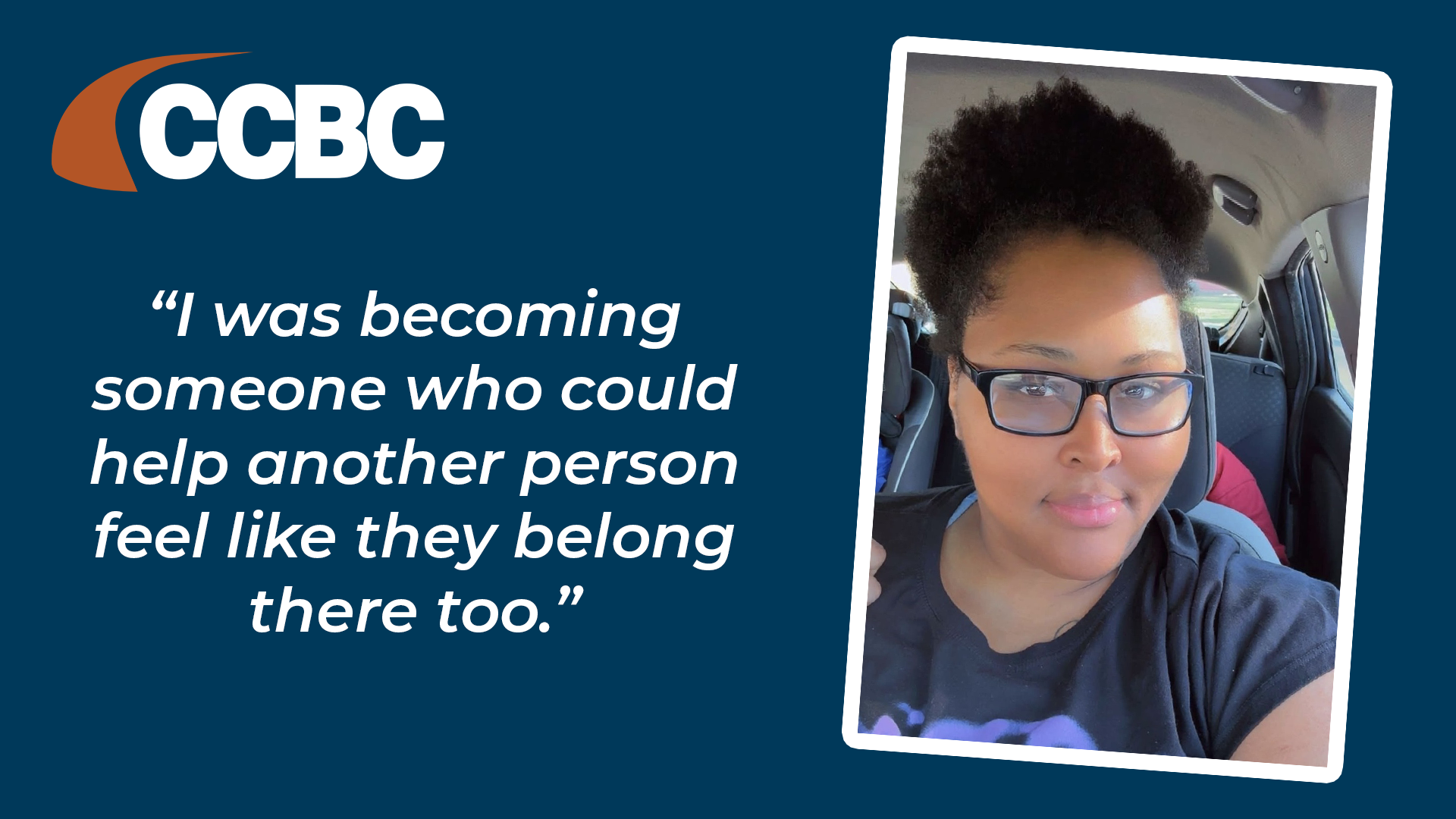
Every semester, a familiar message arrives on Kristina Hauser’s phone: “You belong here.”
At first, it was just another automated reminder from Community College of Beaver County that classes were about to begin. A practical notification. A few words sent to students preparing for another semester.
For Kristina, those words were hard to believe.
When Hauser returned to college after 15 years, she was still rebuilding her life and her confidence. Her earlier college experience had left her questioning whether she belonged in a classroom at all. She had heard so many times that she couldn’t do things or wouldn’t accomplish much that believing otherwise took work.
But she decided to try again.
Hauser described coming across one of those texts while deleting old messages from her phone. This time, instead of scrolling past it, she stopped to consider what it meant.
“Do you really belong here?” she asked herself.
Her answer was simple: “Yes, Kristina, you do.”
Those three words now represent the people who encourage her, the confidence she has slowly regained, and the community she has found while working to rebuild her life.
They reflect a version of herself she is still discovering.
Starting Strong
Returning to school meant balancing more than assignments and class schedules. Hauser was raising her children, navigating uncertainty, and carefully planning how she would manage the demands of college.
She was also investing in herself. While attending therapy twice a week, she began preparing for the semester before classes even started. She obtained syllabi early, reviewed them with her therapist, and mapped out time for studying and homework around her responsibilities at home.
The preparation was practical, but it also reflected something deeper: Kristina was making room for her own future.
“As moms, we put so much effort into our children that we forget to give that energy to ourselves,” she said.
For parents, caring for others can mean putting their own goals aside. Hauser recognized the importance of investing in herself.
That shift can be difficult for anyone whose time and energy are already stretched between family, work, and other responsibilities. Going back to school doesn’t make those demands disappear. It means finding a way to pursue those goals because they matter.
For Hauser, that meant taking a chance on a version of herself she was still learning to believe in. Each assignment completed, question asked, and class attended became another opportunity to see what she could do.
And as her first semester unfolded, she began to find something she hadn’t expected to gain along with her education: a community that helped her feel she belonged.
Finding Her Village
Hauser’s experience at CCBC has been shaped by people who have encouraged her, made time for her questions, and helped her recognize her own potential.
Professor Stacy Freeman became an important source of support. Kristina knew she could ask questions in class and get help whenever she needed it. That willingness to make time for a student mattered, particularly as Hauser worked to rebuild her confidence in the classroom.
Amber Lutes provided another kind of encouragement through the KEYS Program. Weekly check-ins helped Kristina stay accountable, while simple words of support reminded her that she was capable of moving forward.
Other members of the CCBC community helped reinforce that sense of belonging. Professors Amanda Bitkowski and Sonya Kitsko, who taught Hauser sociology and educational psychology, made meaningful contributions to her college experience. Caprice Reed, a part-time criminal justice faculty member whom Hauser knew outside of CCBC, continued to check in and offer encouragement.
Her fellow students became part of that community, too.
One particular moment stood out when a student asked Hauser for help with an assignment. It was a small interaction, but it offered a new perspective. “I was no longer just trying to prove to myself that I could belong in the classroom. I was becoming someone who could help another person feel like they belong there too.”
A supportive community doesn’t remove every obstacle. It can, however, change how someone faces them. For Hauser, those moments of support helped her see that she had a place not only in the classroom, but in the community taking shape around her.
Finding Her Voice
As Hauser grew more comfortable in the classroom, her accomplishments began to reflect the work she had put into returning to school. She earned a place on the President’s List and was nominated for the National Society of Leadership and Success and the DREAM Scholars program.
“Every accomplishment means something to me, but not simply because of the accomplishment itself. Each one is proof that I did not stay where I started,” she stated.
But Hauser’s growth wasn’t measured only by grades or recognition. She was also finding the confidence to share more of herself with others.
That confidence came into focus when she participated in CCBC’s Open Mic Night.
Encouraged by Amber, Kristina chose to share her poem, “I Am From,” in front of peers, faculty, staff, and administrators. The piece draws on her family, identity, motherhood, grief, faith, healing, and the experience of finding her way back to the classroom. It traces the experiences that have shaped her without allowing any one part of her past to define the whole of who she is.
One section touches on returning to education:
“I am from second chances.
From walking back into a classroom
with more life behind me
than I had the first time
and deciding that my past
was not going to have the final word.”
A person’s previous experiences may shape the road ahead, but they don’t have to determine its destination. Returning to school after a difficult chapter can mean walking into a classroom with years of responsibilities, setbacks, and self-doubt that other students may never see. It can also mean bringing perspective, determination, and strengths that weren’t there the first time around.
Hauser’s poem gave her a way to put those experiences into words and to share them on her own terms.
Sharing personal writing takes a different kind of confidence than completing an assignment or earning a good grade. It means allowing others to hear something of your experience and trusting that your words have a place in the room.
“Sometimes the hardest part isn’t finding your voice; it’s having the courage to use it!”
For Hauser, Open Mic Night offered an opportunity to do just that. Her willingness to share her story offers another possibility: what feels difficult to say may also be what helps another person feel less alone.
Looking Ahead
Kristina’s story is still unfolding. Her interest in psychology and mental health has given her direction for the future. She intends to become a therapist, create a nonprofit organization, and be a light to those who are hurting in her community.
In her poem, she connects that aspiration to the importance of being heard and understood:
“I am becoming a future therapist
because I know what it feels like
to need someone to listen without judgment.”
Her words suggest a connection between the support she has sought and received, and the support she hopes to offer others. She knows the value of having someone listen, ask questions, and make room for a person to be honest about what they are going through.
Hauser hadn’t felt heard in other spaces, so she isolated herself for fear of being misunderstood. Her experiences have made her realize how deeply people need connection and how difficult it can be to open up to others. However, she acknowledges one simple fact: “I can’t continue to grow and heal unless I’m putting myself in uncomfortable spaces.”
The student who once questioned whether she belonged in a classroom is earning academic recognition, sharing her writing, and considering how she might use what she has learned to help others.
Her progress is a reminder that starting again doesn’t require having every next step mapped out. Sometimes, it begins with a willingness to explore an interest, accept encouragement, or take one opportunity as it comes.
And a future that once felt difficult to imagine can begin to take shape through those decisions.
Yes, I Belong Here
When Hauser first returned to college, she was trying to figure out where to begin rebuilding her life. Along the way, she found a place where she could begin restoring her belief in herself.
She found instructors who made time for her, a support system that encouraged her to keep going, classmates who welcomed her, and opportunities to discover strengths she hadn’t always recognized in herself.
She found a family.
And the message that arrives at the start of each semester means something different now. What once felt like a question has become a reminder of what she has learned through experience.
In her own words: “I came looking for a place to begin again. I found the village. And now, when that text message comes every semester and says, ‘You belong here,’ I no longer read it as just a reminder that classes are starting. I read it differently because now I know what those words feel like: Yes. I belong here.”
Hauser’s experience is uniquely her own. But the questions at the heart of it—whether it’s too late to start over, whether past setbacks define what comes next, whether there’s a place where you’ll be accepted—aren’t unique to her.
For someone considering a return to college, the first step may feel like the hardest one. For someone balancing family responsibilities with a personal goal, making room for themselves may feel unfamiliar. And for someone who has spent years doubting their abilities, believing in a different future may take time.
Hauser’s story doesn’t suggest that the path will always be easy or that every challenge can be overcome simply by believing in yourself. It shows what is possible when you take a chance on yourself and find people willing to walk alongside you.
“Sometimes rebuilding looks like a professor answering one more question. Sometimes it looks like someone checking in on you. Sometimes it sounds like someone saying, ‘You got this,’ when you are convinced you do not. Sometimes it is being challenged to step outside of your comfort zone. Sometimes it is another student asking you for help and realizing that you have become someone who can give it.”
And sometimes, the words you once struggled to believe begin to feel true.